| Thursday 1/2 |
15:30 |
VP 3: Unfound Footage @ Studio II
|

|
Miss Popularitiy
Is it possible to have two boyfriends at the same time? Certainly, with a bit of organisation! A gay man uses archival footage to describe how he juggles the demands of multiple relationships.
Miss Popularity, ca/de, 2006, 6:20
|
|
Dramatically Repeating Lawrence of Arabia
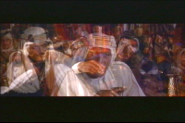
'Dramatically Repeating Lawrence of Arabia' is a re-edit of David Lean's 217-minute orientalist classic 'Lawrence of Arabia' into a 15-minute hallucination of repeating masculinized poses, costumes and dramatic gestures. An algorithmic structure condenses and frame-by-frame remixes the original film into a cycling of divergence, convergence and momentary mirrorings. Stripped of narrational logic and image stability and combined with a re-mix of Maurice Jarre's 'Overture from Lawrence of Arabia', 'Dramatically Repeating Lawrence of Arabia' transforms a Hollywood representation of heroic colonialist history into an affect of melancholy.
Dramatically Repeating Lawrence of Arabia, us, 2004, 14:43
|
|
b-alles
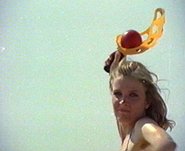
A Greek TV-commercial from the 80s of a product-action racquet game- that failed to become a success in the local market, is being manipulated anew in terms of image and sound. Apart from a funny rhythmical reworking of a rather trite found footage, this work aims at presenting a comical and simplistic view on how American products and trends have been implanted on our collective subconscious through advertising.
b-alles, gr, 2005, 2:00
|
|
La Petite Illusion
A little story of passions is told in 'la petite illusion': heavy breathing garnished by a jazzy bass line, a kiss, a woman falls into water at night. While the work’s title is an ironic reference to Jean Renoir’s 1937 La grande illusion, the association is a dead end: Neither the images nor the soundtrack contains a direct quotation of Renoir’s pacifist fable, nor is a similar motif touched upon. The patina of early sound film which is celebrated in 'la petite illusion' stands as the sole vague connection to the 'grand illusion' - the sound and the look, the aesthetic stereotypes of Francophone cinema made between the wars. Michaela Schwentner’s chromatically ascetic electronic manipulation of found sounds and images is a study of emotional images from the history of cinema which is carefully kept in the air. (Stefan Grissemann, Translation: Steve Wilder)
La Petite Illusion, at, 2006, 03:45
|
|
Heinrich und Mary-Jane
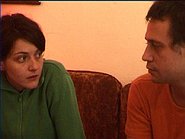
A man and a woman are sitting on a couch. They once were a couple. Whether they still are or aren't anymore isn’t quite clear. Neither to the viewer, nor to them: “Sometimes I hate you for all the things you’ve done to me,” she says. “You know, I love you,” he says. “That’s the thing.”
Stefan Zlamal’s 'Heinrich und Mary-Jane' is a somewhat unusual kind of found-footage film. Instead of rearranging previously shot material, Zlamal worked with two “found” soundtracks, allowing them to collide within the space inhabited by the two: The young woman (Astrid Rausch) whispers, sighs and yells in the voice used to dub Liv Ullmann in the German version of Bergman’s “Scenes from a Marriage.” Her visitor (Wolfgang Dangl) replies with passages from a reading given by Berlin writer Sven Regener.
The form of what is being portrayed contains more information than its content, and so “Heinrich und Mary-Jane” is also about perception in cinema: For both the quarreling couple and us as viewers, the “synchronicity,” literally “togetherness in time,” is revealed to be the grand illusion that it is.
(Quelle: Maya McKechneay, Translation: Steve Wilder)
Heinrich und Mary-Jane, at, 2005, 12:00
|
|
Dubus
Footage from well-known films: ‘Sun Valley Serenade‘, ‘Casablanca‘, ‘Some Like It Hot‘, ‘In the Waterfront‘, ‘Citizen Kane‘ is transformed in order to coincide with new music. A slow dance of the classical cinema to the music of Zelany Rashoho, a mixture of jazz, electronic and dub.
Dubus, ru, 2005, 4:09
|

|
Gospels
'Gospels' strings interview clips of famous Stars together, where it seems to be a lack of clarity as to whom the person on camera is actually referring to. Yet, they all speak of Him. Sometimes the reports on Him seem to reinforce and sometimes they seem to contradict each other. Nevertheless there is something in the tone of their voices and in the way they moved their heads that makes one sense some sort of coherence in their experience.
Gospels, de, 2006, 22:00
|

|
St. Petersburg Paradox
The St. Petersburg paradox is a casino game invented in Russia where prospective players pay an unusually high fee for the right to flip a coin for a modest pot. If the coin lands on heads the player collects the money in the pot. If the coin lands on tails, the pot doubles and the player continues. 'The St. Petersburg Paradox' film works with archival images from the Wolfson Archive of both St. Petersburg, Florida and St. Petersburg, Russia along with images shot in both locations by the filmmaker Mark Boswell. The spectator is navigated, like a situationist video game (based on coin flips), to travel through the past and present of both cities towards a duelling, apocalyptic finish resulting from the historically and ill-fated decisions made by both Russian and U.S. political systems. St. Petersburg, Florida was given its' name in 1882 after Saint Petersburg, Russia, the birthplace of Peter Demens. A local legend says that John C. Williams (founding mayor) and Peter Demens flipped a coin to see who would have the honour of naming the city.
St. Petersburg Paradox, us, 2006, 5:30
|
|


